
On the evidence of Style and diction, it is clear that Anandanubhava knew his Navyanyaya, through the works of Gangesa Upadhyaya. Anandanubhava formulated the logical framework of Advaita, and added to it his very insightful sastric analysis. His writings influenced great scholars Citsukha, the authors of Tattvapradipika and Vimuktatman, the author of Istasiddhi.
Professor Kanshi Ram’s excellent modern translation of Anandanubhava makes available to the contemporary reader both in the east and the west an important works on Advaita, and is likely to prove to be a valuable contribution to I thank Professor Kanshi Ram for his painstaking and laudatory effort.
The Nyayaratnadtpavali consists of four chapters. The scheme adopted in this work does not differ much from that which is followed in the Brahmasl1tras. It has been established in the first chapter that Brahman is both the efficient and the material cause of the universe. Besides, the philosophical issues of significance have also been discussed in the first chapter, for example, the validity of Vedic testimony, the non-human origin of the Vedas, the eternity of varnas, the intrinsic and extrinsic nature of validity, intrinsic nature of the validity of Vedic testimony, the criticism of the Mimamsa view’ that the purport of the scriptural enunciations is action and that the scriptures do not expound anything that is not connected with action, to wit, they do not dwell upon an existent entity, potency as a separate category, the deliberation on the scriptural statement ‘neha nanasti kincana’, the identical nature of Existence, Consciousness and Bliss, Bliss as the nature of soul, positive nature of Bliss, self-luminosity of the soul, the nature of maya, Brahman in association with maya as the material and efficient cause of the creation, the impartite (akhanda) nature of the meaning of the identity propositions (the mahavakyas), etc. The second chapter discusses elaborately the theories of errors, which. is very essential to comprehend the indeterminability (mithyatva) of the phenomena. The positive nature of ajnana is also established in this chapter. In the third chapter, it is established that the immediate knowledge (aparoksajnana) can also arise from the verbal testimony. In this chapter the theory of the combination of knowledge and action (jnanakarmasamuccaya) as a means to Liberation has ‘also been thoroughly discussed and refuted. A very significant philosophical issue, that is, the locus of avidya has also been discussed in this chapter. The fourth chapter discusses the nature of release and liberation during living state.
The importance of the present work is evident from the fact that none other than Citsukhacarya followed its style and method of presentation of philosophical issues, albeit with more precision and lucidity, and quoted and criticised its views on the intrinsic nature of validity, the import of Vedic injunctions, the process of verbal cognition, etc. The significance of the Nyayaratnadtpavali becomes all the more clear from the fact the illustrious Anandajfiana (Anandagiri) wrote an elaborate and lucid commentary entitled Vedantaviveka on it. The work is difficult as it is written in a terse, sastric and logical style. The analysis of philosophical problems is done with the help of syllogistic propositions. Their treatment and the discussion based on the fallacies of reason render the work rather abstruse.
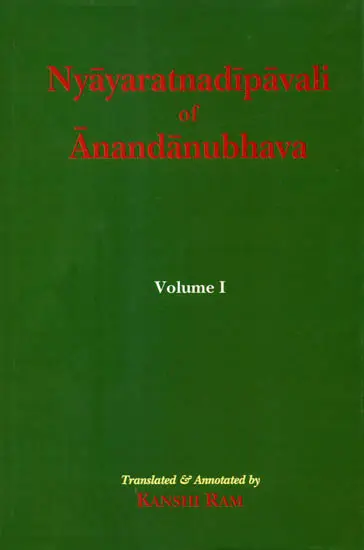
The present volume contains the annotated translation of the first chapter of the Nyayaratnadtpavali in which several important philosophical issues have been discussed as given above. Since the nature of the work is terse and also teems with logical niceties, the annotations based on the commentary of Anandajfiana- have helped in bringing out the import of the philosophical issues more lucidly.
Although the Madras Government publication is critically edited, it contains many errors. It is the typographical and punctuational errors that sometimes make the comprehension of the text rather difficult. At some places in the text, even the topical headings are not consonant with the text so demarcated. The demarcation itself is defective at several places. I have tried my level best to give the correct text in the Devanagart and also punctuation marks wherever they help in making the sense of the text easy of comprehension. On page 115 of NRD, I have emended the demarcated text. The topical heading ‘Prabhakarasankasamadhanam’ should have included the text beginning with ‘na’ occurring in the first line on page 115 of NRD, and not ‘na’ in the fourth line as is given in the present edition.
I have given the text in Devanagan along with its topical headings as I have found them in the Madras Government publication except some headings given in the Topical Contents’. The obvious errors have been corrected. This renders the text somewhat easy to understand.
The Sanskrit text is followed by the translation in English which is further followed by annotations based on the Vedanta- viveka by Anandajnana. I have tried to explain the syllogistic propositions with the help of illustrations from the basic Nyaya texts, such as Tarkasangraha, Nyayasiddhantamuktavalr, etc. so that the fallacies may be understood easily. This facilitates in appreciating the Advaita position vis-a-vis the Buddhist, Nyaya, Mtmarnsa, etc.
It is a relatively free translation so that it may enable the reader to understand what Anandanubhava has got to say on the philosophical issues he has taken up for deliberation. For the same reason, I did make the proposal to the ICPR to include the annotations based on the Vedantaviveka, the elaborate commentary on the present work written by Anandagiri so that the issues discussed in the tat may be rendered easy of comprehension.
I place this work before the learned readers. I hope that I would be benefited from the feedback both in respect of errors and conceptual inadequacy or ambiguity as these shortcomings might remain in such a work even though it has been carefully gone through and proof-read by me and Dr. Ratish Chandra Jha, I will definitely emend the present work in the light of the suggestions received whenever I am called upon to do so.


Reviews
There are no reviews yet.